This is a short update on the progress of Calder, the University’s next High-Performance Computing (HPC) cluster.
It has been a little while since the March Calder update, so this is a short progress note on where things are now and what happens next.
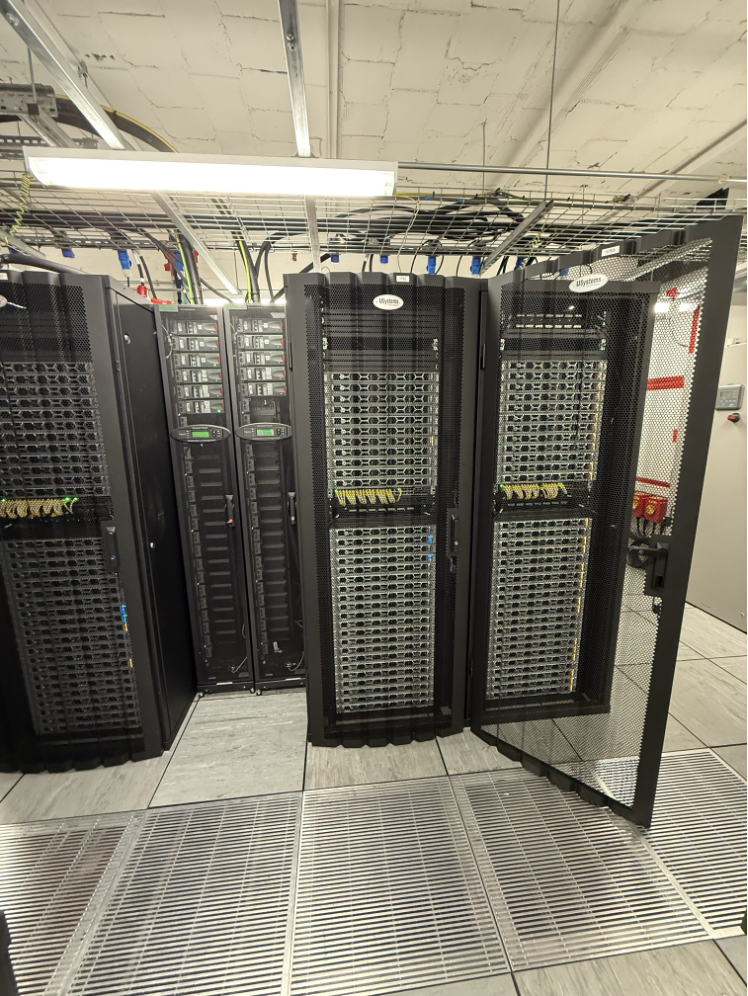
Since March, a lot of the work has been less visible than a hardware delivery photo, but it has been important. Calder’s nodes and storage are now racked, firmware and BIOS updates have been applied across the estate, and the GPU nodes have been checked by Dell as part of the enhanced support service. They validated the new GPU nodes by checking hardware health, firmware, GPUs, networking and system configuration, ensuring the platform is fully supported, reliable and ready for production use.
There have also been a few practical challenges along the way. Delivery of some power supply modules took longer than expected, some InfiniBand cables were not the ones needed, and a small number of floor tiles were damaged during installation and had to be repaired. Calder has been a bit like a brilliant new colleague with an impressive CV: clearly destined for great things, but currently still asking where the kettle is.
Some of these delays reflect a wider market issue. Large data centre customers, including major AI and cloud providers, are buying specialist components quickly and in high volume. That can make supply chains for items such as power and high-performance networking components less predictable than we would like.
What has happened since March
- All Calder nodes and storage have been racked.
- Firmware and BIOS have been updated to the latest stable versions across all nodes.
- The GPU nodes have been checked by Dell as part of the enhanced support service.
- The team has refined the controlled build and security approach, including network segmentation, managed authentication, multi-factor authentication, logging, monitoring and endpoint protection on login nodes.
What is ready now
A minimal Calder system is now being prepared for penetration testing. This representative setup consists of two CPU nodes, two GPU nodes, management nodes, gateway nodes and supporting storage.
This approach means the most important access routes, permissions, authentication, security controls and core HPC functionality can be tested without waiting for every node in the full system to be brought online.
While penetration testing is taking place, the rest of the Calder system will continue to be brought online and configured.
What happens next
- Penetration testing is expected to take place within the next two weeks.
- Any findings from penetration testing will be reviewed and addressed before wider access is enabled.
- The remaining hardware will continue to be brought online while the representative system is tested.
- Research Infrastructure Engineering and Research Software Engineering teams will carry out technical validation of the system.
- Users can now express their interest in testing Calder by completing the Evaluation Partner expression of interest form.
- User Acceptance Testing will use the representative system first; it does not require the full Calder estate to be available before testing starts.
We will share a further update once penetration testing has been completed and the User Acceptance Testing plan has been confirmed.
If you would like to be involved in User Acceptance Testing, fill out the EoI Form and look out for invitations starting from 13th July onwards, with access being offered in stages as different components of the system become available.
If you’d like to keep up with future updates about Calder and our wider HPC ecosystem, consider joining the Research Computing Community. It’s a simple way to stay informed about new capabilities, planned improvements, and opportunities to get more involved.
And if new CPU nodes and power distribution modules are your thing, here you are: