I’m not a programmer, but I want to use computational methods to explore perspectives and experiences creatively. I need pathways that give me freedom and flexibility. In an underfunded field, finding affordable support that understands my goals and respects my methods and skillset feels like asking for the impossible.
– I. Maginary, Arts and Humanities Researcher
In this article, we explore how digital research infrastructure designed for science can create unexpected barriers for researchers in the arts and humanities. We’ll share insights from recent conversations about what arts-focused infrastructure might look like – from training that speaks to creative and interpretive goals, to support for the diverse, often non-standardisable workflows that characterise humanities research. You’ll find reflections on what we’ve learned, examples of what’s possible, and an invitation to help shape what comes next.
Defining Digital Research Infrastructure
Digital Research Infrastructure (DRI) encompasses the computational tools, services, and support systems that enable researchers to conduct their work. This includes high-performance computing resources, research software and platforms, data storage and management systems, as well as the training, documentation, and community support that help researchers use these tools effectively. It’s the entire ecosystem that makes computational research possible – not just the technology itself, but the knowledge and networks that make it accessible and useful.
Understanding the landscape
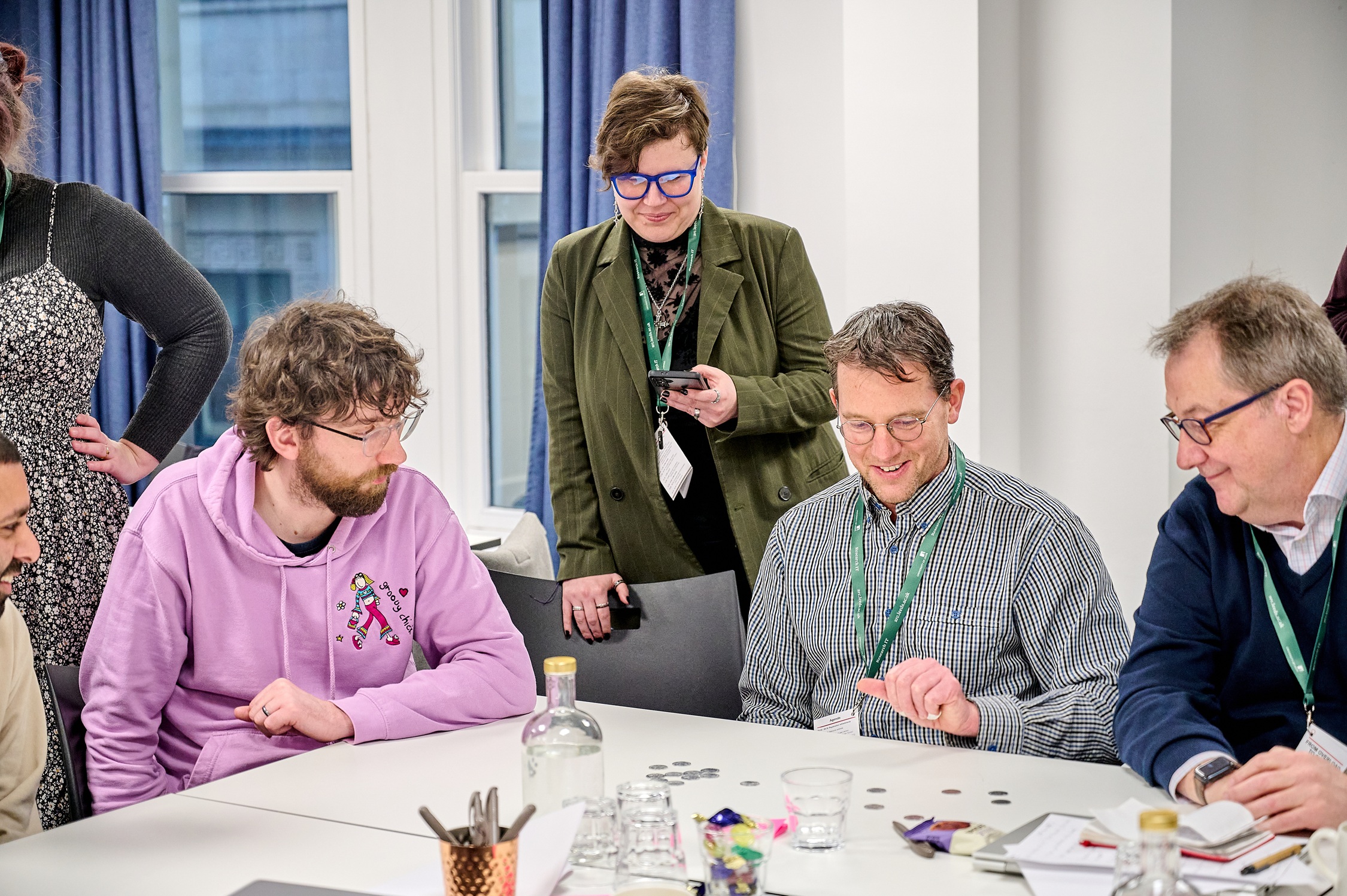
We’ve been working with colleagues from the Library’s Digital Research Infrastructure team and the Digital Creativity and Cultures Hub (DCCH) to understand what arts and humanities researchers need from computational infrastructure. Recently, we attended CPP-AHC Edinburgh and DARIAH Day 2025 – two events bringing together researchers, infrastructure providers, and funders to explore current challenges and imagine better futures for digital research infrastructure in arts and humanities. We’ve also been visiting different schools in the Faculty of Arts, Humanities, and Culture (AHC) at Leeds to learn about the computational work they’re doing. Here’s what we’ve learned so far.
Challenge 1: Different working realities
We teach reproducible workflows, version control, and standardized data management because we assume that’s how most of our users work. But what about the artist who wants to iterate and explore? The humanities researcher who’s asking interpretive questions rather than testing hypotheses?
Infrastructure that is geared towards scientific research currently asks: “Can others replicate your results?” Arts/humanities might ask: “Can I explore, create, and share my process?”
This difference in values isn’t just theoretical. Recent research by Dr. Francisco Queiroz in the University of Leeds School of Design surveyed computational scientists and creative practitioners who use software tools with text-based user interfaces, including generative AI tools, and compared their attitudes toward the software tools they use [1]. Their findings revealed an interesting pattern: computational scientists placed higher value on reproducibility when using text-based interfaces for their research, while artists and designers were notably less concerned with reproducibility. This makes sense when the goal is creative exploration rather than validating scientific claims.
The survey also revealed something unexpected: computational scientists were less concerned about results matching their expectations than artists and designers were. At first this seems counterintuitive, but it makes sense when you consider that scientists follow processes specifically designed to anticipate and explore unexpected outcomes. Artists, however, often want more control over their creative output – the ‘black box’ of AI generation can be frustrating when you have a specific creative vision.
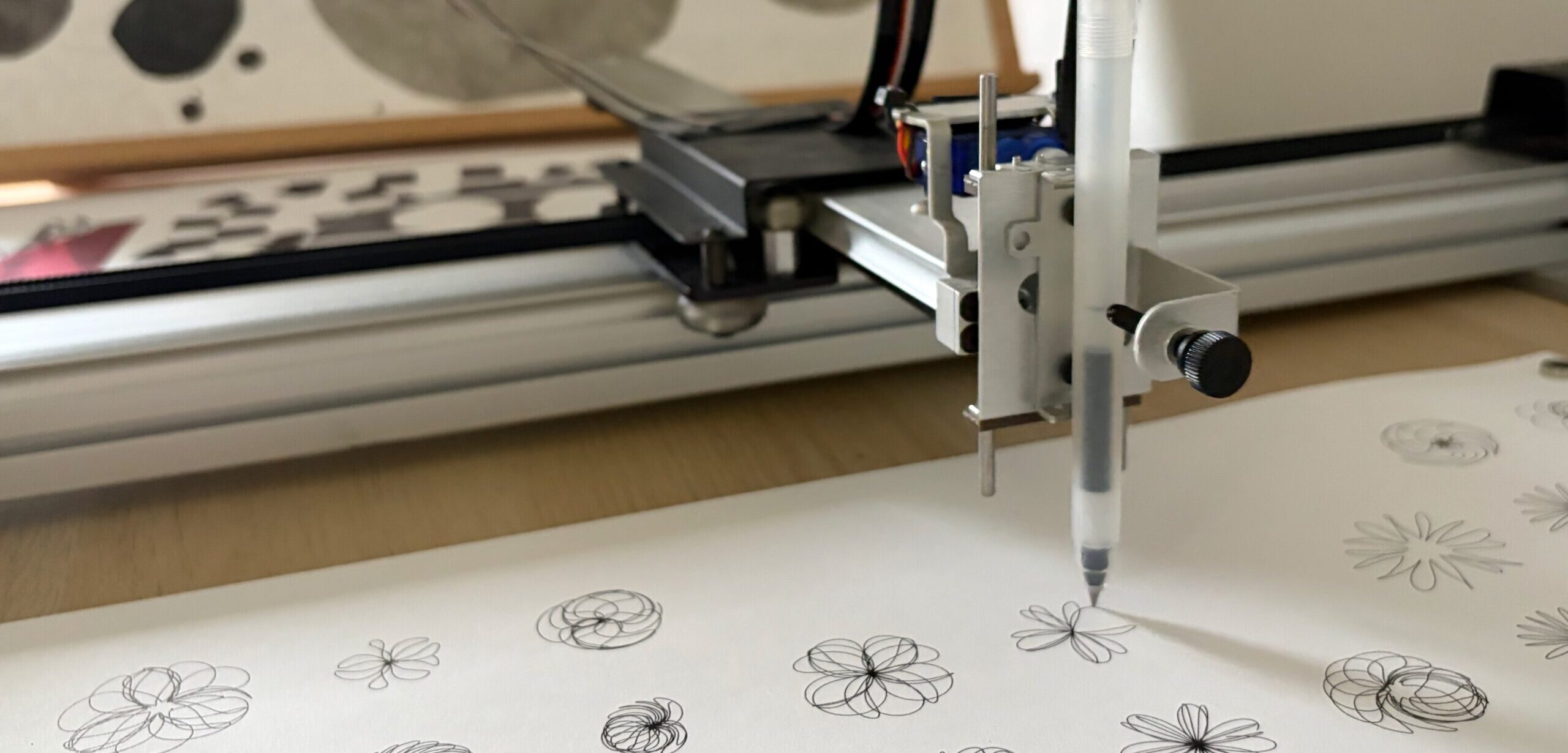
Leeds arts researcher, Jan Hopkins, uses her computer as a ‘creative partner’ in her work involving programmatical control of a drawing machine [2]. She told us,
My code is probably messy and full of bugs but that’s all part of the process to me and I’m tolerant of quirks and misbehaviour.
– Jan Hopkins, Arts Researcher
There’s another important distinction: arts and humanities researchers often aren’t looking to replace their methods with computational approaches—they want to augment their interpretation with digital tools. A literature researcher, for instance, might create a data visualisation to support and guide close reading of a text, not to replace it, much like artists like Jan engage with machines in creative partnership.
Challenge 2: The language barrier
One of the challenges in supporting computational research across the arts and humanities is simply talking about it. The diversity of data, materials, and methods in humanities research makes it difficult to identify common ground or shared approaches – even when they exist.
Humanities researchers work with materials so varied that their computational workflows resist easy categorisation. What works for optical character recognition of medieval manuscripts might be irrelevant for someone analysing performance videos or mapping historical networks. This diversity makes it challenging to recognise when researchers face similar computational problems, just in different disciplinary contexts.
It’s not so much that the computational methods have different names – a neural network is still a neural network – but that the problems are described in entirely different disciplinary languages. Each field has its own acronyms, its own ways of framing research questions, its own vocabulary for describing materials and methods. For example, an ‘archive’ means something different to a historian and a computer scientist. This makes it challenging for researchers to identify when approaches from other disciplines might be relevant to their work.
For those of us concerned with building digital infrastructure, the language diversity presents a third challenge: how do we engage with users across fields when everyone speaks a different language? User engagement is essential for evolving our services to meet real needs, but getting their attention and holding a conversation is difficult when each community frames their computational challenges differently. How do we ask questions that resonate with a medieval historian, a creative practitioner, and a linguist? How do we synthesise insights from conversations where the same underlying need might be expressed in completely different terms? Building infrastructure that truly serves diverse disciplines requires first finding ways to have conversations that bridge these language barriers.
Challenge 3: One size doesn’t fit all
STEM researchers typically come to us needing more computational power, making centralized HPC resources the obvious solution. But arts and humanities researchers often have different requirements that centralized infrastructure doesn’t address well.
Arts and humanities research is often dispersed. It uses data owned by many institutions across national and continental borders, and it focuses on individuals’ and small groups’ research interests. Consider an arts researcher wanting to experiment with low-resource LLMs or render 3D animations, or a business researcher preparing multi-source datasets for analytics. These users need accessible, flexible compute resources and support for their specific workflows—not necessarily access to a supercomputer. It’s like offering HS2 when what they actually need is a reliable local bus service.
For many arts and humanities researchers, a more distributed, people-focused infrastructure might be more valuable—one built around understanding their actual problems and working collaboratively to solve them, rather than simply providing access to large-scale resources.
Projects like the recent UKRI-funded work at University of Arts London are exploring how to better support collaborative creation and use of data, models, and code within creative communities. These initiatives will surface insights about what arts and humanities researchers need from digital infrastructure—and those of us designing and delivering these services should be paying attention.
Not only does the physical infrastructure need to accommodate diversity, so too must our training and other forms of learning support. As Professor Rebecca Fiebrink of UAL reminds us,
Big challenges are often conceptual in addition to technical – helping people understand what is actually possible and finding/creating learning resources that are appropriate for practitioners whose backgrounds and needs are a bit different from those targeted by most resources on the web.
Towards a better future
We’re taking small but deliberate steps to address these challenges, steps such as:
Building relationships and understanding
- Visit schools across AHC to engage researchers directly, learn about their challenges, and provide tailored guidance
- Collaborate with colleagues in DCCH, LAHRI, and across professional services to design support that meets real user needs and moves computational humanities research out of its silo
- Publish case studies showing how computational methods apply directly to arts and humanities research
- Continue to support AHC colleagues through consultancy services, helping scope and cost digital research elements in funding proposals
Expanding learning opportunities
- Develop AHC-focused training and learning resources in partnership with subject experts
- Create Research Computing internships for AHC students, building on the successful N8 summer internship programme. These placements bring fresh perspectives into faculties while exposing students to diverse research challenges—we particularly welcome projects from underrepresented fields
- Signpost existing platforms and resources designed for arts and humanities researchers, such as:
How you can help
If these challenges resonate with you, we’d love to hear from you in one or more of these ways:
- Tell us your challenges: What barriers do you face bringing digital methods into your research? How might the University’s infrastructure help?
- Invite us to visit: We’d welcome the opportunity to meet with your faculty or school
- Propose an internship project: Submit ideas for small-scale computational projects in your research area, regardless of whether you currently work with computational methods
- Share your work: We’re collecting case studies from arts and humanities researchers using computational methods, regardless of your level of expertise or whether you identify as a ‘computational scholar
Get in touch
You can get in touch with our team by submitting a Research Computing Query (login required) or emailing RCTeam.
References
[1] Queiroz, F. (2025). Comparación del uso de software científico y herramientas de arte de IA generativa: investigación exploratoria y agenda futura [Comparison of the use of scientific software and generative AI art tools: exploratory research and future agenda]. INMATERIAL. Diseño, Arte y Sociedad, 10(19), 96–121. https://doi.org/10.46516/inmaterial.v10.240
[2] Spencer, C. (2023, July 6). Snooping through studios: Jan Hopkins. The State Of The Arts. https://www.thestateofthearts.co.uk/features/snooping-through-studios-jan-hopkins/
Cover image credits: Jan Hopkins (2025), Machine Drawing Sine Flowers