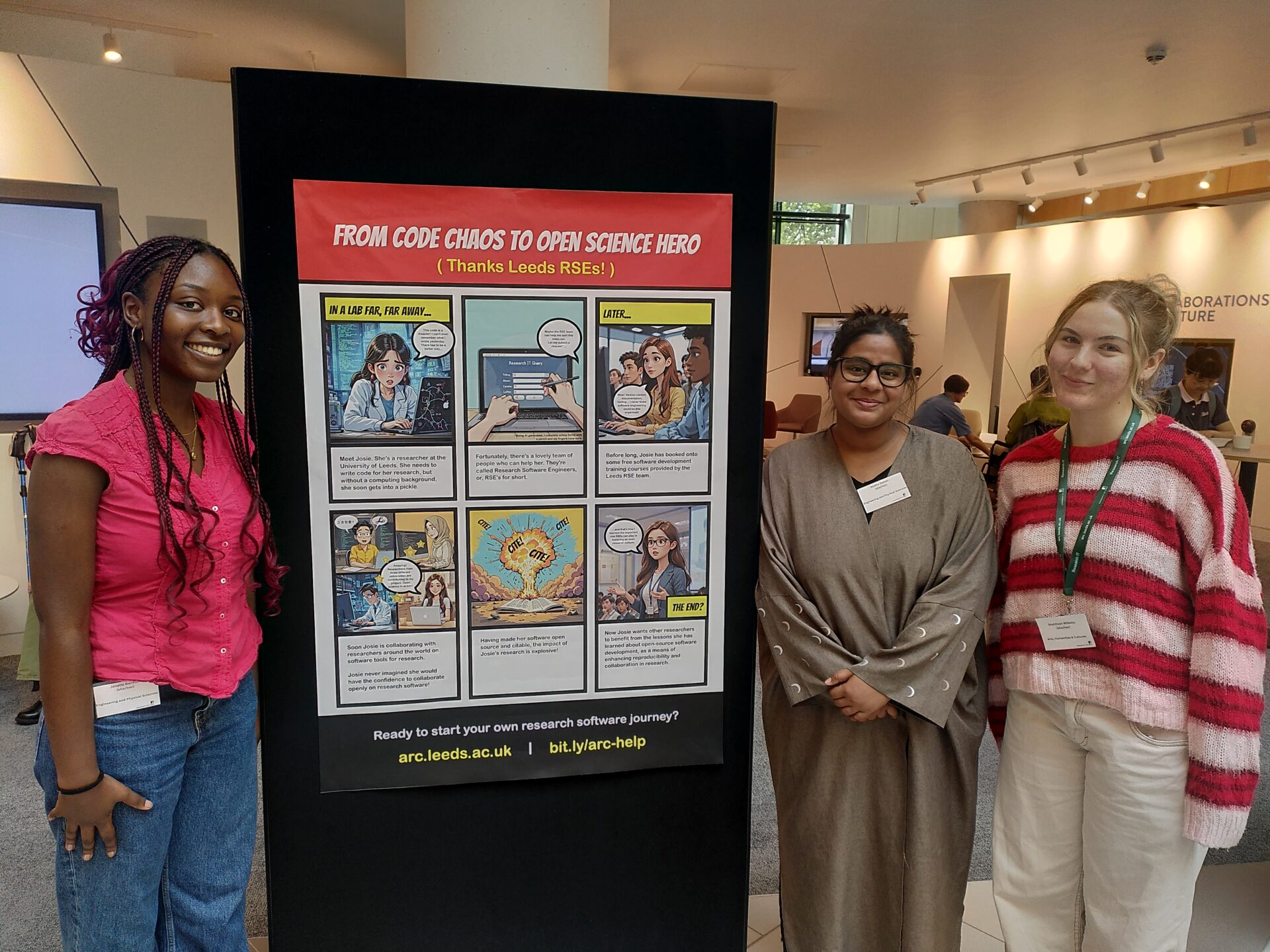
This summer, our Research Computing team hosted three interns through the N8 CIR Summer Internship Programme. Each intern tackled real research challenges under academic supervision while developing technical skills that will shape their future careers.
What makes these projects special? Each intern started with minimal experience in software engineering, yet delivered working prototypes that researchers can actually use.
Want to join next year’s programme or propose a project? Join our mailing list for updates.
Digital Tools Meet Victorian Literature
- Intern: Maddie
- Project: From Modern Tweets to Victorian Broadsheets: Sentiment Analysis Software for Victorian Literature
- Principal Investigator: Dr Emily Middleton, School of English
- Challenge: Existing sentiment analysis tools use modern language patterns, making them useless for historical texts.
The Problem You Face as a Literature Researcher
Standard sentiment analysis tools fail when you study historical periods. They miss context-specific terms and evolving language meanings. You need programming skills just to customize basic tools.
The Solution Maddie Built
She developed Python-based software that lets you:
- Create custom sentiment lexicons for your specific research period
- Easily visualise the differences in output between different analysis methods
- Analyse texts without needing programming knowledge
From Zero to Working Prototype
Maddie started the internship with no coding experience. Eight weeks later, she delivered a functional tool her supervisor can build upon.
Emily Middleton, Principal Investigator:
Maddie did incredibly valuable work in scoping out what tools were out there, and in exploring ways of solving the problems the project presented. Her prototype is not only something we can build on, but is immediately useful. What she’s achieved is particularly impressive given that she doesn’t come from a computer science background, and she tackled the project in a professional, thoughtful and creative manner.
Presentation
Understanding How AI Models Think
- Intern: Jenelle
- Project: What do Large Language Models Know? Text Simplification Analysis
- Principal Investigator: Nouran Khallaf, Centre for Translation Studies
- Challenge: AI models simplify text, but researchers can’t see how they make decisions.
Why AI Transparency Matters for Your Research
When you use AI tools, do you trust their outputs? As AI becomes standard in research, you need to understand how these models reach their conclusions.
Comparing Two AI Explanation Tools
Jenelle tested two tools designed to explain AI decision-making:
- Captum (by Meta)
- Circuit-tracer (by Anthropic)
She used these tools with the gemma-2-2b-it language model to analyse how AI simplifies complex sentences.
Research Impact Beyond the Code
The project created benchmarks other researchers can use to evaluate AI explanation tools. It bridges digital humanities and machine learning in ways that benefit both fields.
Jenelle’s Key Learnings
There are many lessons that I have learnt in this internship, however, the most notable has definitely been having confidence in the work you are doing. This was something that I had found difficult before this internship but working in research relies on this notion and therefore pushed me out of my comfort zone.
Presentation
Rebooting Mental Health Ward Assessment
- Intern: Mysha
- Project: #WardSonar – Digital Platform for Mental Health Ward Environment Assessment
- Principal Investigator: Professor John Baker, School of Healthcare
- Challenge: Reviving and updating a mental health ward environment monitoring tool.
Real-World Healthcare Technology
Mysha worked on a platform that helps staff monitor the therapeutic environment in mental health wards. Working with healthcare technology means navigating regulations, user privacy, and real-world deployment challenges.
The technical challenges included:
- Anonymous patient data collection
- Staff dashboard development
- NHS-compatible licensing arrangements
- Hospital network restrictions
John Baker, Principal Investigator:
Mysha showed a real interest in the topic and a willingness to apply her learning in a different context. She clearly rose to the challenge of having to work out a range of different processes which would enable patients to anonymously enter data and staff to be able to see a dashboard of the findings. This was not an easy task and a previous technology company had spent a considerable amount of time developing #WardSonar the first time.
What These Projects Mean for Research Computing
These internships created a ripple effect beyond individual learning experiences.
Fresh Perspectives Drive Innovation
Sorrel Harriet, RSE:
Hosting the interns this summer was great for our team. Not only did it give us opportunities to develop our mentoring and coaching skills, it brought fresh ideas and perspectives into the team. It also helped us to connect with academics in different parts of the University, who may not otherwise have known about or used our services. The insight it gave us into their needs and challenges will help us evolve our service offerings in the future, so we can better serve a broad user base.
Building Bridges Between Disciplines
Each project connected different research areas:
- Literature studies + software engineering
- Linguistics + machine learning
- Healthcare + digital platforms
These connections create new possibilities for future research collaboration.
Your Next Steps
Are you an academic with a research challenge that software could solve? Or an undergraduate interested in applying technical skills to real research problems?
The 2026 internship programme will open soon. Visit the N8 CIR website to learn about opportunities and application requirements.
These three projects prove that eight weeks can transform both research problems and student careers. What will next year’s interns create?